Next-Level AI Fraud: How "Virtual Girls" Drain Millions from Ad Networks
Cybersecurity experts from DoubleVerify have found a new vulnerability in AdTech. The scheme has been dubbed DreamScheme. By parasitizing on people's desire to look at neural network-generated girls, the creators of this scheme have drained millions of dollars from ad networks.
For those who purchase traffic, this is a clear example of how deeply AI fraud has penetrated the ad fraud landscape.
How the Trap Works
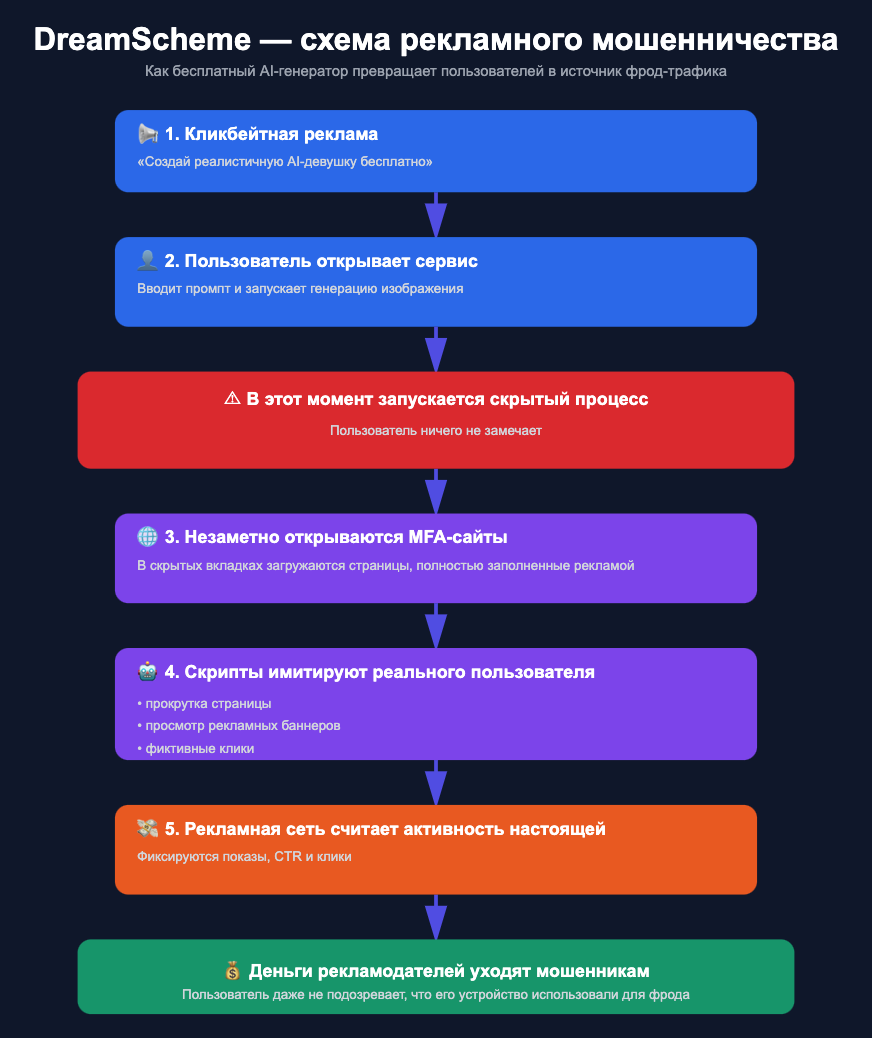
The fraudsters played on the audience's curiosity. They created websites and apps where users can generate an image of a beautiful girl using a text description for free. While the user is choosing a prompt and waiting for the result, the software quietly opens hidden browser tabs.
In these tabs, junk sites created solely for the sake of advertising are loaded. Scripts simulate the behavior of a living person. They scroll the page, hover the cursor over banners, and make fake clicks on their own. Ad exchanges see this activity, count the impressions, and charge advertisers' budgets, transferring the money to the creators of the scheme. Real users do not even suspect that their devices are being used to inflate activity.
Ad networks have already started a cleanup. Google Ads, Meta, and major programmatic platforms are mass-banning accounts that advertise AI generators. Regular buyers who use AI-generated girls in their creatives are also falling victim to these bans.
How to Protect Your Budgets
If you think a regular blacklist or a simple tracker will save you from this kind of fraud, we have bad news. Because DreamScheme uses the real devices of users (their home internet, clean IPs, and real cookies), this traffic looks perfect to standard filtration systems.
To avoid paying for invisible impressions, you will have to protect your budget on a much deeper level.
-
Forget about CPM on questionable platforms. Switch to pay-per-lead or pay-per-action models. A bot can perfectly simulate a click and a view in a hidden window, but it will not enter real card details or confirm a phone number via SMS.
-
Implement viewability tracking. Connect third-party software that verifies whether the banner was physically located on the user's screen.
-
Monitor the time-to-conversion. If exactly 1–2 seconds pass from the banner click to registration on the landing page, it means an auto-fill script worked in the background. A live person cannot fill out a form that quickly.