In just one month, Russians lost access to four major cryptocurrency exchanges. In October, Bitget, MEXC, HTX and KuCoin announced one after another that they would no longer serve users from Russia. Most also stopped serving users from Belarus, while Bitget extended its restrictions to Kazakhstan. Three of the four exchanges rank among the top ten largest on CoinMarketCap, and KuCoin alone has around 45 million users, according to Crypto Briefing.
Traders aren't the only ones affected. USDT has long become a common currency for payments: affiliate networks pay affiliate marketers in it, while clients use it to pay freelancers, copywriters, designers and developers. Many kept their earnings directly on exchanges because it was convenient to sell USDT through P2P and receive rubles or tenge on a bank card. Some have already received emails with withdrawal deadlines, KuCoin introduced restrictions on the same day it announced its exit, and those using the remaining exchanges don't know whether their platform will be next.
But there's no need to panic yet: reliable ways to store USDT and exchange it for rubles or tenge are still available. We'll explain what to do if your funds are stuck on an exchange that has left the market, which platforms are still operating and where it's safer to store USDT.
Which exchanges left Russia and CIS countries in 2026
We've put together a table of exchanges that stopped serving users from Russia and neighboring countries in 2026. Some announced their deadlines in advance, while others introduced restrictions immediately:
|
Exchange |
Announcement date |
Restricted countries |
Withdrawal status |
|
Gate |
Summer 2026 |
Russia |
Shut down ruble P2P trading and added Russia to its list of restricted countries. Keeping funds there is risky for Russian users |
|
CoinEx |
September 15 |
All countries |
Trading stopped on September 29, and funds can be withdrawn until December 22, 2026. After that, a monthly 5% fee will be charged for holding unwithdrawn funds |
|
Bitget |
October 16 |
Russia, Belarus, Kazakhstan |
The exchange described this as a one-time measure affecting some users. Withdrawal deadlines were sent by email, and many have already expired |
|
MEXC |
October 20 |
Russia, Belarus |
New orders were disabled on October 24, and forced position closures began on October 28. Withdrawal deadlines are communicated to users individually |
|
HTX |
October 23 |
Russia |
Users are being told to withdraw their assets within seven business days. The exchange has not officially announced a single deadline |
|
KuCoin |
October 29 |
Russia, Belarus |
Restrictions took effect immediately. Withdrawal deadlines and instructions are sent through notifications |
Exchanges determine exactly who is affected by the restrictions based on verification data: they have both your passport details and your country of residence. Bitget's rules refer to those who live or conduct business in prohibited countries, while HTX also includes those who are simply located in Russia. MEXC and KuCoin don't disclose their criteria and send notifications to specific users.
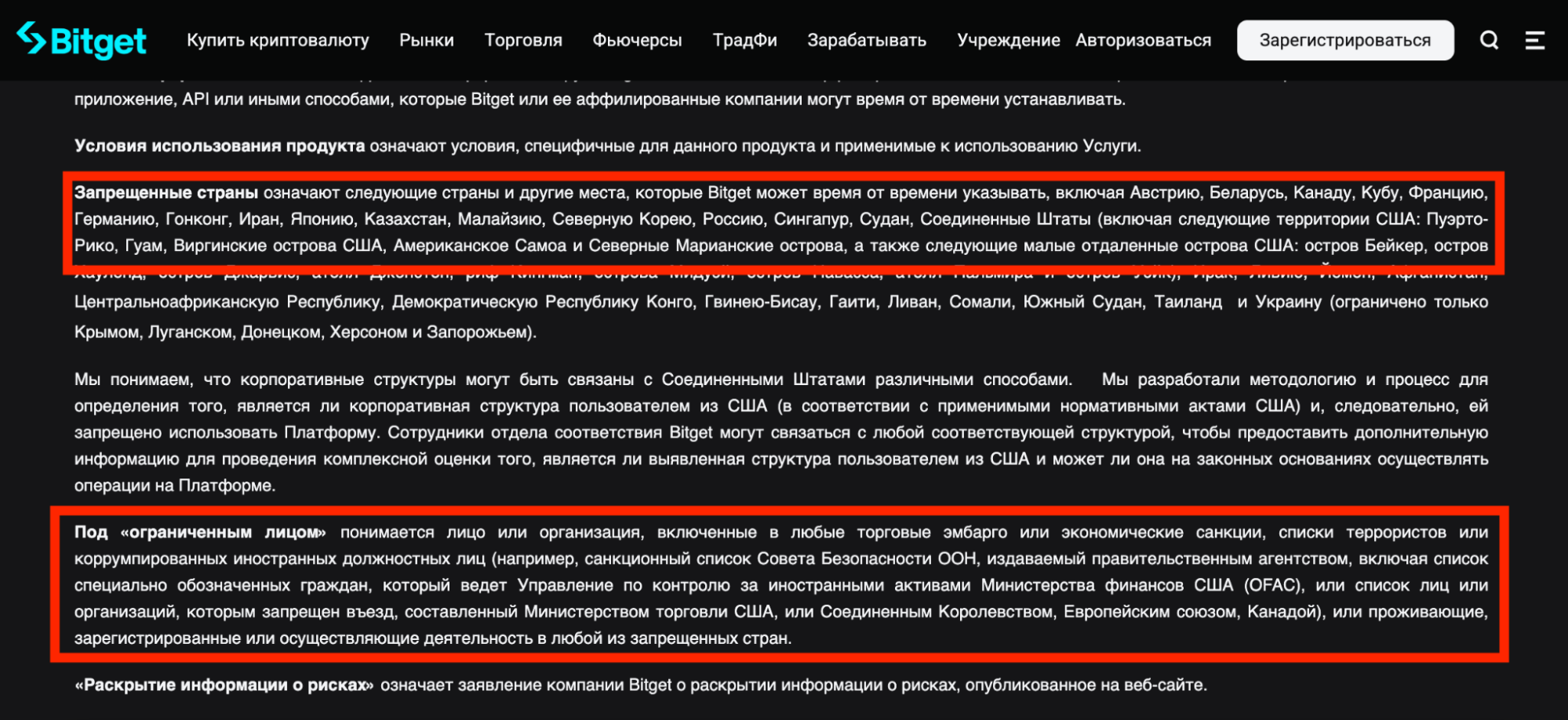
Image source: bitget.com
If you haven't received an email from MEXC or KuCoin, your account is still operating normally for now. However, you shouldn't assume things will stay that way — it's better to move your funds in advance to somewhere they won't get stuck.
How to withdraw USDT from an exchange that has left the market
Exchanges leaving the market aren't taking users' money: they're giving customers time to close positions and withdraw their assets. The main thing — is to meet the deadline stated in your notification.
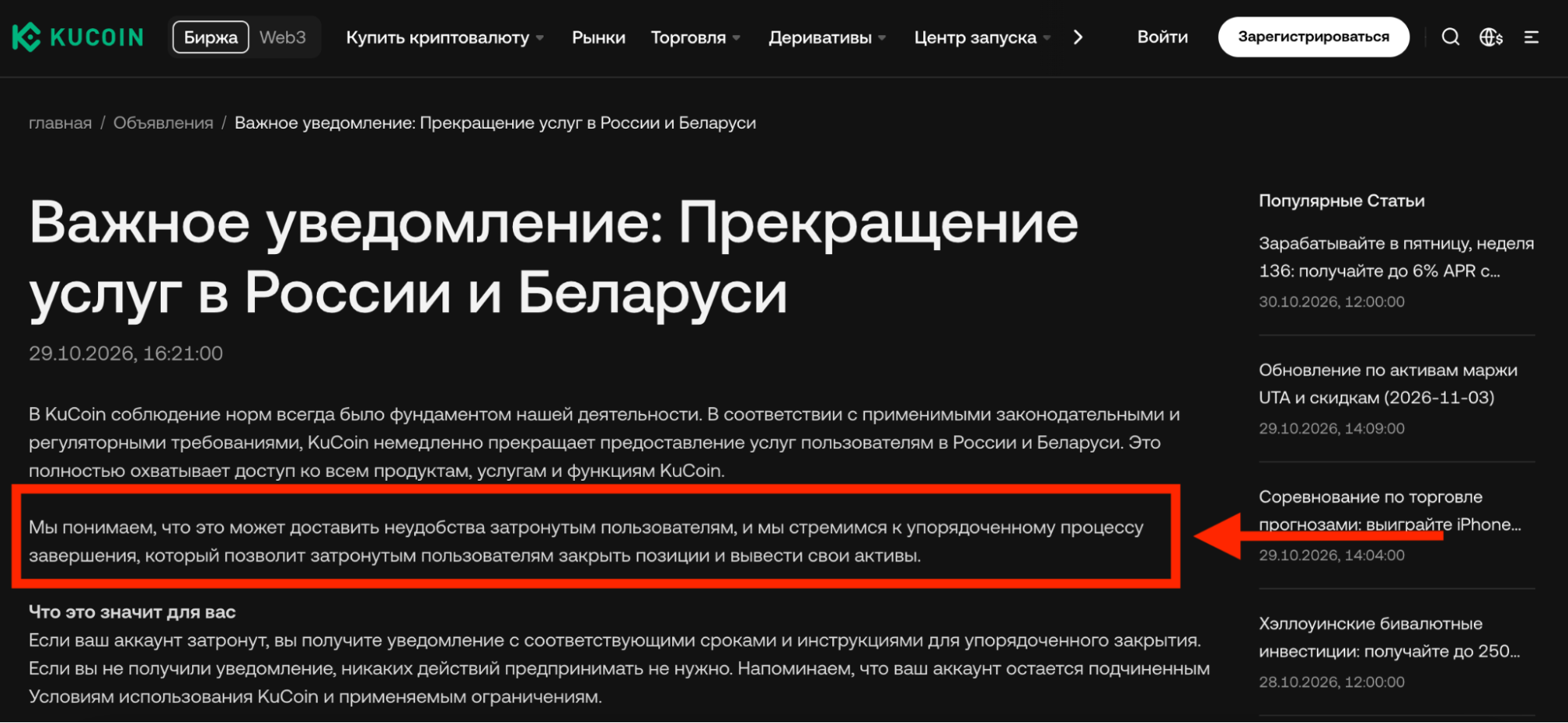
Image source: kucoin.com
-
Check your email and notifications in the exchange's app. Bitget, MEXC and KuCoin communicate withdrawal deadlines individually to each user, so there is no single deadline. If you don't see an email in your inbox, check your spam folder.
-
Only log in through the official app or website. MEXC and KuCoin have explicitly warned that scammers are sending fake emails containing «withdrawal instructions». Don't follow links from emails or chats, and contact support only through the exchange's official channels.
-
Close your positions yourself. If you don't do it in time, the exchange will forcibly close them at the current market price — MEXC, for example, has already started doing this.
-
Consolidate all your funds into one balance. Withdraw funds from Earn and staking, stop trading bots, and transfer the remaining balance from your futures account to your main account. Sell coins for USDT if they aren't supported by the exchange or wallet you're withdrawing to, while trading is still available. This is especially important for rare altcoins: MEXC and KuCoin were among the first platforms to list them, and many other exchanges simply don't support these coins.
-
Export your transaction history. While you still have access to your account, download the complete history of trades, deposits and withdrawals. If a new exchange asks where your money came from during verification, this export will be your main proof.
-
Decide where to withdraw your funds. The most reliable option — is a personal crypto wallet, which we'll discuss below. If you want to move your money to another exchange, first make sure it serves users from your country. Otherwise, you may have to rescue your funds a second time.
Watch out for warning signs as well: while withdrawing from Russia, Gate and HTX shut down ruble P2P trading, and HTX also stopped registering new users. If your exchange starts doing something similar, don't keep large amounts of money there.
Be prepared for AML checks too: exchanges examine which addresses your coins have passed through in the past and may freeze your entire account if their history is considered «dirty», until you prove the source of the funds. That's why it's safer to withdraw large amounts to a personal wallet first and send only the amount you intend to sell to an exchange.
If the deadline has already passed, contact support through the official chat on the website or in the app, and save screenshots of your balance and correspondence. HTX's rules, for example, allow the exchange to freeze withdrawals for users from prohibited countries, but that doesn't mean the money is gone — Bitget and MEXC have separately stated that customer funds are safe.
Which crypto exchanges operate in Russia, Kazakhstan and Belarus in 2026
The situation differs in each country: in Russia, exchanges are leaving voluntarily, while in Kazakhstan and Belarus, local authorities are restricting the market. So let's look at each country separately.
Russia
Among major exchanges, Bybit, BingX and OKX continue to serve Russian users — they haven't added Russia to their lists of prohibited countries yet:
-
Bybit — the main platform for Russians: it has the largest number of Russian users and the biggest ruble P2P market. However, Russian banks have been absent from the list of payment methods since October 2025: select Bank Transfer, and the seller will specify the required bank in the listing.
-
BingX — also offers ruble P2P trading, with sellers accepting transfers through Russia's Faster Payments System (SBP) and to Russian bank cards.
-
OKX — serves Russian users, but the ruble has been unavailable on its P2P platform since 2023, making it more suitable for storing and trading crypto than withdrawing funds to a bank card.
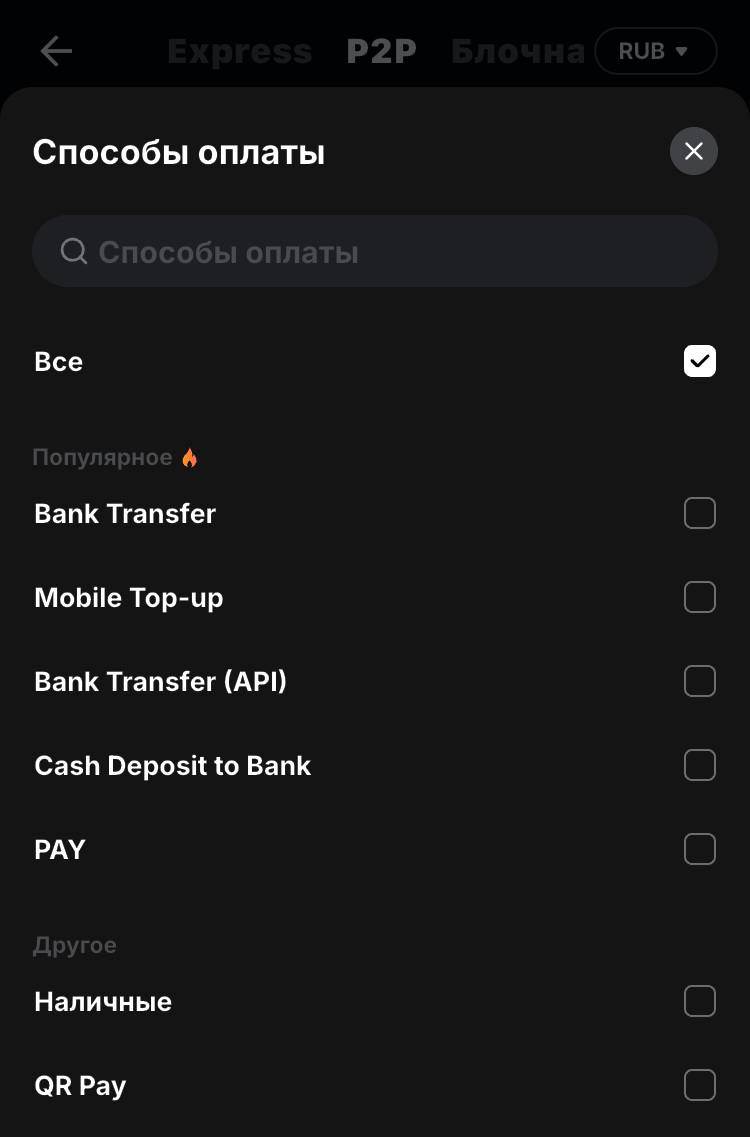
Image source: bybit.com
You shouldn't keep all your money on just one of these exchanges: only a month ago, MEXC and KuCoin were also on this list. It's better to open accounts on two exchanges so that if one leaves the market, you won't have to urgently search for a new one and rush through verification.
Kazakhstan
Only exchanges with a local license can legally operate here. Among international exchanges, Binance and Bybit have received full licenses, while ATAIX Eurasia has one among local exchanges. Binance's and Bybit's Kazakhstan divisions are connected to local banks: tenge can be deposited into Bybit through Bank CenterCredit and into Binance through Freedom Bank, so P2P isn't necessary. In September, the AIFC court prohibited six unlicensed exchanges, including BingX, HTX and Coinbase, from operating in the country. If your funds are held on one of these platforms, transfer them to a licensed exchange.
Belarus
The situation is toughest for Belarusians. Under Decree No. 367, individuals can buy and sell cryptocurrency for money only through exchanges that are residents of the High-Tech Park: Bynex, Whitebird, Free2ex and others. Transactions on foreign platforms are illegal, and the websites of Bybit, BingX, Bitget and OKX have been blocked in Belarus since December 2025. That's why Belarusians are better off transferring funds from exchanges that have left the market directly to local platforms. The exception — is those living abroad: the decree doesn't prohibit them from using foreign exchanges and withdrawing funds to a foreign bank account.
Where to store USDT: reliable crypto wallets
There are two types of crypto wallets. In a custodial wallet, a company holds the keys to your funds, just like on an exchange: it's convenient, but access can be restricted. In a non-custodial wallet, only you hold the keys, in the form of a 12- or 24-word recovery phrase, and no one can block such a wallet. The second option is better for storing your earnings. The main thing — is to write down the phrase on paper and never store it in your phone's notes or in the cloud: whoever knows the phrase controls the money.
Trust Wallet
One of the most popular non-custodial wallets, supporting more than 100 networks, including USDT on TRON, TON and Ethereum. No verification is required, and it works in Russia without restrictions. It's suitable if you receive USDT on different networks and want to keep everything in one app.
Keeper (formerly Tonkeeper)
Previously, this was a wallet for the TON network, but now it also supports TRON, Ethereum, Bitcoin and other networks. Its main feature — is «Battery»: it pays transfer fees, allowing you to send USDT even if your wallet doesn't contain TRX or GRAM (the new name for the former Toncoin).
TronLink
The official wallet of the TRON network, convenient for those who receive USDT TRC-20. To transfer USDT on this network, you need to keep some TRX in your wallet to cover fees, but TronLink offers a GasFree mode where fees are deducted directly in USDT.
Hardware wallets
A hardware wallet — is a separate device about the size of a USB flash drive or bank card that stores the keys to your funds. Every transfer must be confirmed on the device itself, so scammers can't withdraw your money even if they infect your phone or computer with malware. A wallet like this is worth buying for anyone who keeps significant savings in cryptocurrency.
Hardware wallets work in any country. The only difficulty for Russians is purchasing one: Ledger and Trezor don't officially ship to Russia, but they can be bought from resellers, while Tangem is available through both resellers and marketplaces. Only buy a new device in sealed packaging. Never buy a used wallet: its previous owner may have recorded the recovery phrase and could withdraw your funds at any time.
Telegram
There are now two wallets available here:
-
Walt (formerly Wallet, accessible through @walt or the old @wallet) — is custodial: the service holds the keys, and basic verification is required. However, it includes a P2P marketplace where you can sell USDT for rubles or tenge. Russia, Belarus and Kazakhstan aren't listed among the unsupported countries.
-
The new «Money» wallet in Telegram settings — is non-custodial, but it's designed for GRAM, gifts and usernames.
However, Telegram itself experiences disruptions in Russia, so keeping all your savings in Walt is risky — it's better to use it for quick transfers and sales.
FAQ
How can you withdraw USDT to a bank card?
In Russia, you can sell USDT for rubles through P2P on Bybit or BingX, or through the P2P marketplace in Telegram's Walt wallet. In Kazakhstan, licensed exchanges Bybit and Binance allow tenge withdrawals directly to a local bank card without P2P, while in Belarus, withdrawals are available through exchanges and exchange services registered with the High-Tech Park. However, Russian banks have long been blocking cards used for P2P sales, especially when money arrives frequently from different strangers. To avoid additional risks, accept payment only from the person whose name appears in the transaction: money sent by a third party may have been stolen from a scam victim, and you'll be the one dealing with the bank.
What will change for USDT holders in Russia on July 1, 2027?
P2P transactions between individuals through Russian banks or in cash will become illegal, with fines of up to 40% of the transaction amount. Selling USDT for rubles will only be possible through brokers and exchange services registered with the Central Bank: you send the coins to an intermediary and receive rubles in your account. Buying USDT with rubles will also have to go through them, but the purchased coins will be held in a special account with the intermediary, and you won't be allowed to transfer them to a personal wallet or foreign exchange. In addition, Russian banks will be prohibited from transferring money to crypto services without a Russian license. However, the law doesn't prohibit selling USDT on a foreign exchange and withdrawing the money to your own foreign bank account.
Can you receive payment in USDT from a client?
It depends on who the client is. Since September 1, 2026, Federal Law No. 282-FZ explicitly allows cryptocurrency payments under contracts with foreign companies or foreign individuals — such contracts can be entered into by both private individuals and sole proprietors. However, accepting crypto payments from a Russian client is prohibited: the ban existed before, but cryptocurrency is now considered a currency asset, and violations can result in fines of 20–40% of the transaction amount. Keep in mind that every Russian citizen is considered a Russian currency resident, even if they live in another country.
Can you recover USDT if you sent it through the wrong network?
Sometimes, yes. If you sent USDT to your personal wallet but selected, for example, BEP-20 instead of ERC-20, the funds aren't lost: these networks use the same address format, and you only need to enable the correct network in your wallet settings for the coins to appear. However, if you sent USDT to an exchange through a network it doesn't support for deposits, contact support and provide the transaction hash. Some exchanges recover such transfers manually, but they don't guarantee recovery and may charge a fee.