
CS2 case farming — is one of the most straightforward and stable ways to earn money on Steam. The idea is simple: a network of profiles is assembled, special software automatically grinds the weekly experience in the game, collects the dropped items, and sends them for sale.
This niche does not involve working with ad accounts, social media moderation, or complex funnels. Income depends entirely on the number of active accounts in the network and the correct software setup.
Let's look at how the economics of case farms work, what technical setup is needed to get started, and how to protect the network from Valve bans.
How the economics of case farms work and how much they earn
Earnings from farms are based on the weekly in-game drop mechanic — the Care Package.
Once a week, after gaining the first profile rank (which requires earning 5 000 XP), the game offers a set of four items, from which the player chooses two. The set always includes one weapon container (a case or terminal), while the other three slots contain skins from active collections and graffiti. Farmers always take the container and the most liquid item from the remaining ones.
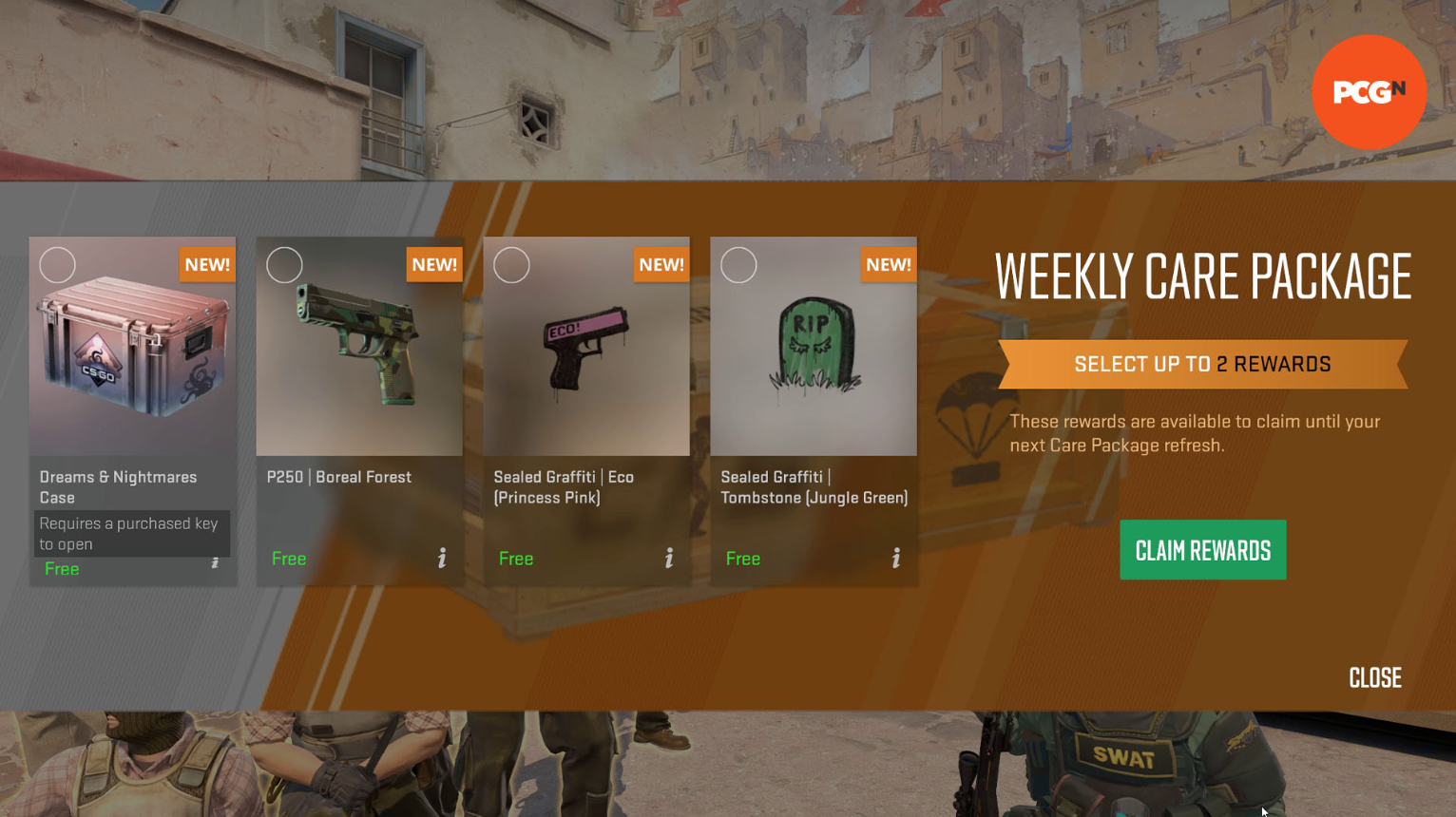
What drops and how much it costs
The game's active pool contains 5 items (current cases and terminals). The value of a drop depends on exactly what drops: newer containers trade for around $1–$2, while the other items in the active pool cost around $0.40–$0.70. On average, one weekly drop brings in around $0.60–$0.80 net.
Drops are only given to accounts with CS2 Prime status. Experience and rewards are locked on free profiles.
Basic economic calculation for 50 accounts
If the network has 50 Prime accounts and each receives a weekly Care Package, this amounts to around 200 containers per month.
From there, everything depends on the price of the specific drop: cases and terminals have different prices, and market prices constantly change. Therefore, fixed profit per account should only be treated as a guideline.
For a rough calculation, you can use an average container price of $0,70:
200 containers × $0,70 = $140 in gross monthly revenue.
The farm expenses are deducted from this amount:
-
Proxies — if a separate IP is used for several accounts;
-
Automated farming software — a subscription to a panel or farming software;
-
Selling fees — depend on the platform used to cash out the drops.
The costs of purchasing the accounts themselves and Prime status are calculated separately as initial investments.
Ultimately, profit should not be calculated using only the formula «number of accounts × case price». It makes sense to launch a small network first, check the actual drops and expenses, and only then scale the farm.
Who buys these containers and why
If millions of players receive free drops every week, a logical question arises: why is there constant demand for them?
The economy is based on the fact that in-game cases are consumable items that are quickly used up:
-
Players and streamers: To open a container, a key is purchased for $2,5. When opened, the case permanently disappears from the system, and a random skin or knife drops in return. An ordinary player receives only one free container per week, but during one evening, caught up in the excitement, they may open 20, 50, or 100 in a row. All of these are purchased on the market.
-
Gaming websites and roulette sites: Hundreds of third-party services operate online where users open cases or spin skin roulettes. To keep these websites running and distribute winnings in skins or cases, their owners constantly purchase drops in bulk from marketplaces.
-
Investors: Over time, old cases leave the active pool and stop dropping. Their total number on the market only decreases with every opening, so traders buy them for the long term in the hope that their price will increase.
As a result, market demand constantly exceeds the supply from ordinary players, while farm owners act as regular suppliers of this liquid product.
Which accounts to use for a farm
The choice depends on your budget and whether you are willing to spend time preparing profiles before launch.
1. Autoreg and self-registered accounts
They are used for large-scale farms when a network needs to be assembled with minimal initial investment:
-
What needs to be done manually: purchase and activate CS2 Prime status, deposit $5 to remove the trading limit, and link Steam Guard protection yourself through the SDA program.
-
Limitation: after linking the protection, you will have to wait 7 days for Valve's mandatory trade hold on item transfers to expire.
-
Who they are suitable for: those who are willing to spend time on manual setup to save on the cost of each account.
2. Farmed accounts with Prime, aging, and gaming hours
These are ready-made profiles that are already fully configured for use with the software:
-
What they include: Prime has already been purchased, the $5 limit has been removed, gaming hours have been boosted, and Steam Guard protection has already been linked.
-
Advantage: the 7-day trade hold has already expired. The profile does not require manual preparation: it is immediately loaded into the software, connected to a proxy, and sent to farm its first drop.
-
Who they are suitable for: those who value a quick launch without routine work and minimal attention from Valve's anti-fraud system due to the account's age.
The main general rule for any accounts: CS2 Prime status must be active during farming, otherwise the game simply will not award the weekly Care Package.
Technical setup: what you need for launch and automation
For the farm to generate passive income, all routine tasks are handled by software. Three basic tools are needed to build a working setup:
1. Farming panel
This is multi-launch software that manages all processes inside the game:
-
Launches multiple CS2 windows simultaneously in groups of 5–15, minimized at the minimum resolution of 640×480 and with reduced graphics settings to avoid overloading the graphics card and processor.
-
Simulates player actions using the built-in WalkBot algorithm, moving characters around the server to prevent disconnection for being AFK.
-
Tracks the accumulation of 5 000 XP and automatically collects the dropped container from the Care Package into the inventory.
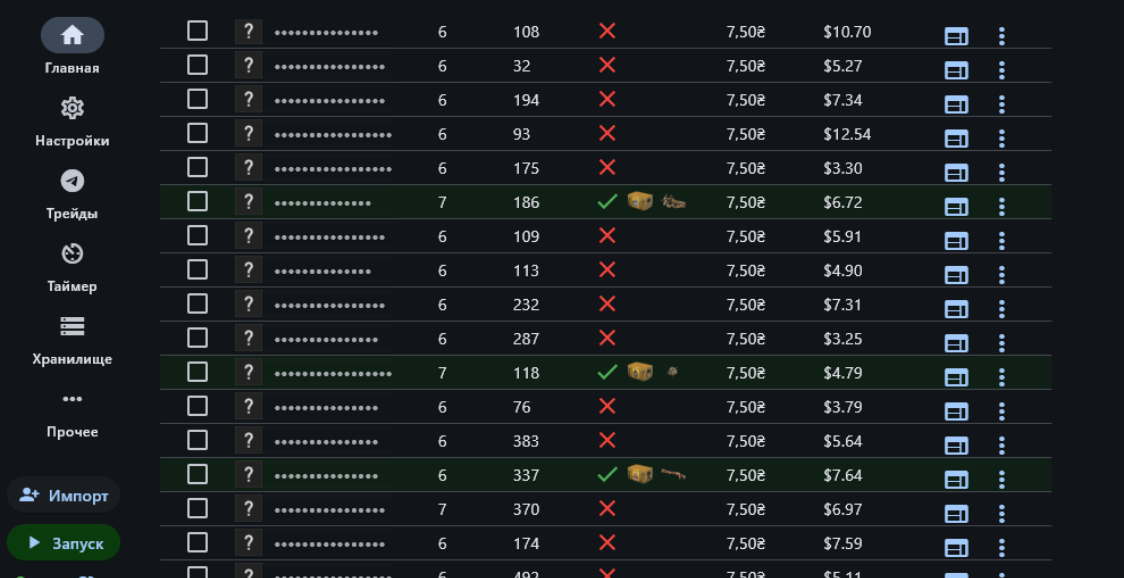
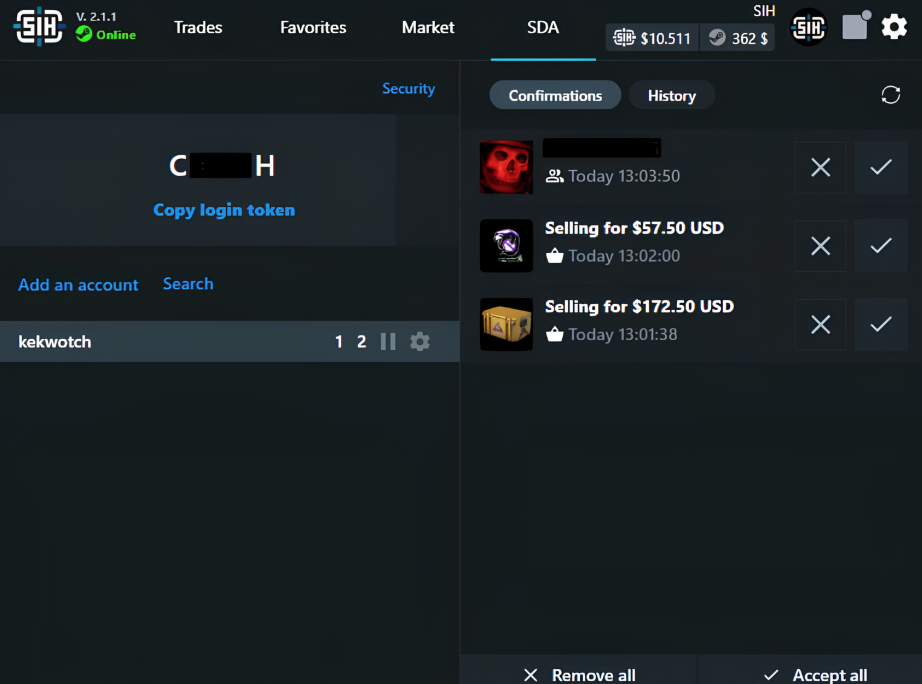
2. Steam Desktop Authenticator
A PC program that replaces the Steam Guard mobile app.
It stores the authentication keys for all accounts in the network in one place. Through SDA, the software automatically logs into the profiles, while bulk case transfers can be confirmed in a couple of clicks without manually entering codes from a phone.
3. Private proxies
The entire network cannot be run from one home IP address: Valve's anti-fraud system links mass activity and may ban the entire group of profiles.
For this purpose, static datacenter IPv4 proxies or mobile proxies are used. The optimal load is no more than 3–5 accounts per IP.
Once the account base has been assembled and the software configured, all that remains is to proceed to the final stage — collecting the drops and cashing out the money.
How to cash out drops into real money
Selling containers on the Steam Community Market itself is pointless: the money will remain in the internal wallet, from which it cannot officially be withdrawn to a bank card or cryptocurrency.
Farmers use third-party services to cash out real money. The entire process is divided into two main routes:
1. P2P marketplaces. You list containers for sale through a marketplace website. When a buyer is found, the software or extension automatically sends the trade directly to their inventory through SDA:
-
Pros: minimal service fees (usually from 2% to 6%) and the best final selling price.
-
Cons: you need to wait until a real buyer is found for the specific listing.
-
Withdrawal of funds: directly to a card, bank account, or cryptocurrency (USDT, LTC).
2. Buyout services. Platforms that purchase the entire inventory immediately using their bots within a couple of seconds:
-
Pros: instant payout in cryptocurrency or to a card without waiting for buyers. Suitable when you need to sell a large batch of drops from the entire network at once.
-
Cons: platforms apply a discount for speed — the final amount will be 10–20% below the market value.
How drop collection from the network is automated
To avoid selling items manually from 50 different accounts, centralized collection is configured:
-
One trusted main account is designated.
-
Once a week, through the farming panel or auto-trade scripts, the entire network automatically transfers the received containers to this profile.
-
The batch of drops is then listed on the marketplace from the main account and cashed out into fiat or USDT.
Main risks and how to protect the network from bans
The main danger for the farm — is Valve's anti-fraud system. If the system suspects automation or links the accounts together, the entire network may be banned.
Three simple rules help keep the farm safe:
-
No shared data. Steam bans spread through linked accounts: if one phone number is linked to multiple profiles, a ban on one account will automatically destroy all the others. A separate email is used for each profile, and one number is never used for the entire network.
-
Simulating the behavior of a real player. If bots enter the game simultaneously and move according to identical patterns, Valve will immediately detect automated farming. To avoid this, launch delays are configured in the software settings, and random movements, jumps, and pauses are enabled.
-
Careful drop collection. If 50 cases from the entire network are transferred to one new empty account, Steam will block that profile for suspicious trades. Drops are transferred gradually: pauses are made between trades, or cases are sold directly from each account through P2P marketplaces.
It is easier to start with 5–10 accounts. This is enough to configure the software without rushing, test withdrawals to a card or cryptocurrency, and make sure the combo works reliably.
Conclusion
CS2 farming — is a volume-based technical business. There is no complex marketing, audience management, or heavy dependence on social media algorithms. Profit is generated in a straightforward way: the number of active profiles is multiplied by the average price of a weekly container.
However, this niche should not be viewed as an easy button for passive income. The farm's success depends on three things:
-
Proper budget calculation: understanding how much will be spent on the initial purchase of Prime and how much will be deducted in cash-out fees;
-
Basic security: separating emails, working through proxies, and protection against chain bans from Valve;
-
Gradual scaling: launching a small test pool to check the software before purchasing a large network.
With the software properly configured and the accounts isolated, the network runs on full autopilot and generates stable income with minimal time spent on monitoring.