The 2026 TikTok Organic Traffic (UBT) Storm: How to Bypass Anti-Fraud During the World Cup
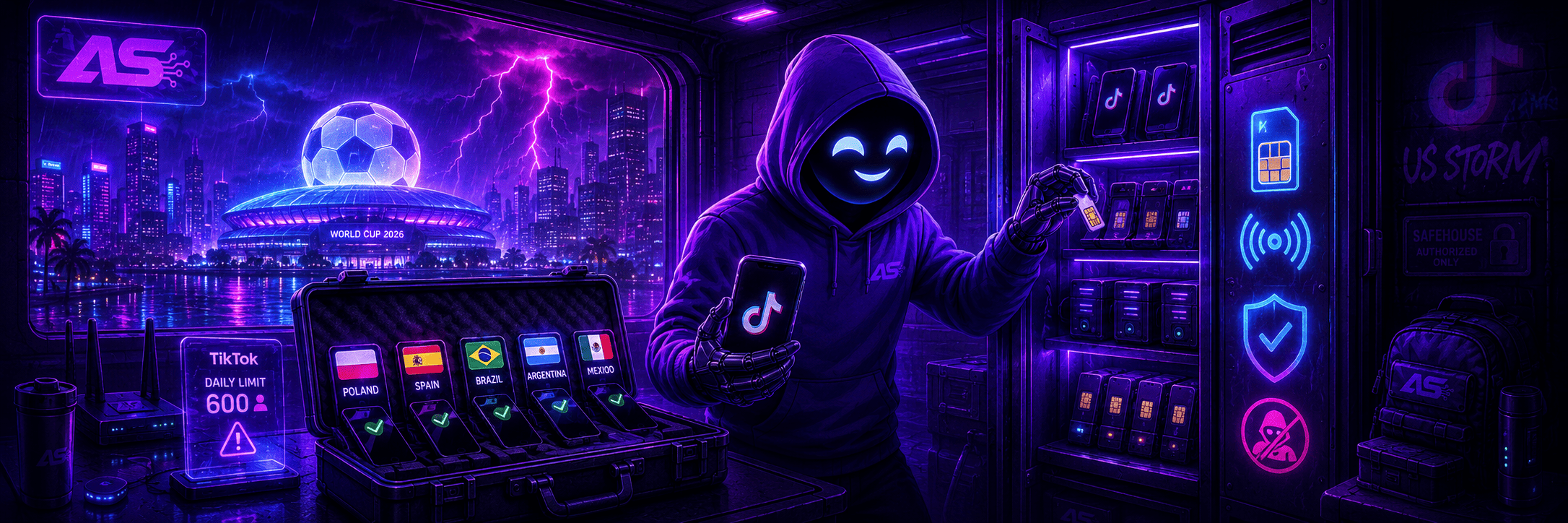
Driving free traffic (UBT) on TikTok targeting the US is currently hitting strict limits: most accounts fail to break past the 600-view mark. This drop is directly linked to the World Cup taking place in the States, which has put the platform's servers under immense load. Due to the massive influx of users, moderation algorithms are tightening internal filters, leading to widespread issues when registering US emails and causing reach to plummet.
To avoid running accounts in vain, you need to change your approach to driving traffic or temporarily switch to other regions. In this article, we break down why the US GEO is experiencing a storm and how the technical side of working with mobile proxies is structured right now.
We have prepared a step-by-step framework for launching profiles, gathered a list of 11 stable countries across Europe and Latin America, and detailed the principles of checking your setups for shadowbans.
US Limit Drops: How the 2026 World Cup is Breaking Moderation and Servers
Periodic storms in TikTok are a standard part of the job that every media buyer regularly faces. A "storm" typically refers to periods when the platform's algorithms drastically tighten checks or specific features within the source break down.
Over the past two years, the platform has survived dozens of such moments, but none of them killed traffic generation entirely. Moderation issues affect the entire market as a whole, and once a storm ends, the filters often loosen up, which is compensated for by an increase in conversions and traffic volume.
Such disruptions happen regularly. Micro-storms ahead of TikTok updates occur every 3–4 weeks and usually last just one or two evenings. Global technical issues happen once every few months and can drag on for one to two weeks, affecting even regular users. A separate category includes storms during major global events, when social networks purposefully ramp up their moderation.
During these moments, standard setups break down: linking third-party profiles fails, or mass account registration becomes significantly harder. Frequently, the anti-fraud system tightens hardware filters on Android, causing a device to allow launching only a single account before requiring a full factory reset. The platform also begins handing out shadowbans for mentions in comments, profile descriptions, or for using specific tags.
Following a recent algorithm update, running traffic to the US has become much more difficult. The primary symptom on accounts is a hard limit of 600 views, above which videos simply do not climb.
In parallel, technical issues emerged at the registration stage: US Hotmail emails constantly experience delays during profile creation, and during server drops, up to 30% of the Gmail pool lags as well. The Downdetector chart for the US consistently shows spikes in user complaints during these days, especially during night hours.
The root of these disruptions is global—the 2026 World Cup, which is currently taking place in the United States. To understand the scale: the last tournament was watched by roughly 4 billion people, meaning half of the planet's population.
When an event of this magnitude unfolds within a single GEO, the load on the platform's servers increases exponentially. The network is choked with millions of videos and livestreams, causing TikTok's anti-fraud system to misbehave. Algorithms perceive mass registrations and traffic surges as artificial manipulation and suppress reach. This storm will last for at least another month while the tournament is ongoing, so expecting stable moderation for the US right now is pointless.
Technical Setup for the Storm: Session Management, Mobile Proxies, and SIM Trust
The cleanliness of your mobile proxies determines whether an account gains reach or if videos stall at the first hundred views. TikTok's anti-fraud checks IP addresses at the network request level, so standard proxy/VPN services immediately result in a traffic drop.
Before launching, you need to test every subnet through checkers like IPhey or Pixelscan to detect DNS leaks. Even high-quality mobile proxies won't deliver results if the exact same address range is simultaneously being used on other devices. If traffic is being driven in parallel on the same subnet, TikTok simply cuts views across the entire batch of accounts.
To ensure account longevity, use an authorization flow via Google. First, log into the profile using a Google account; it just needs to remain active in your session. After registration, pause for 30 minutes, and then leave it in that session for at least 5 hours. Without this warm-up period, the platform's algorithms won't push videos to recommendations. That's it—only after this can you start running traffic on this account.
You can run traffic without a physical SIM card, but in that case, the requirements for mobile proxy cleanliness skyrocket. Having a SIM card inside the device significantly boosts trust: when a device contains a SIM, the system flags you as a regular user and bans the account less frequently.
Right now, the platform is actively combatting automation by cross-referencing the IP address with the smartphone's actual physical GEO. If session parameters trigger suspicion in the filters, the new profile gets hit with a shadowban before the very first post.
Temporary GEO Shifting: Moving Volumes to Stable European Regions
If the US GEO starts storming heavily, the easiest way out is to temporarily shift to Europe or the CIS. While things are glitching over there, other countries perform normally even during major updates. Granted, moderation in Europe is inherently stricter, but its rules are clear and don't fluctuate every two hours due to network overload. The anti-fraud system there operates in standard mode, meaning accounts get sent for verification less often.
Currently, 11 countries are highly suitable for account purchases and registration: Poland, Moldova, France, Ukraine, Brazil, Romania, Hungary, Czech Republic, Kazakhstan, Germany, and Spain. When setting up a phone to target these regions, you must completely strip out all US-related data.
In your device settings, configure the language of the target country, the corresponding region, and the proxy's time zone. For example, if you are working with Polish accounts, ensure both the proxies and the phone settings are explicitly customized for Poland.
The cross-GEO traffic setup (where an account is registered in one country but traffic is pushed to another) frequently results in zero views right now, so it is best to operate strictly within a single region.
Isolating a Shadowban: The "Wall" Verification Method and New AI Triggers
When videos start hitting zero views or getting shadowbanned, it's not always solely due to TikTok's internal storms. It is crucial to understand the difference between platform-wide technical glitches and the exact moment the anti-fraud system flags your specific setup: the creative, hashtags, calls to action, or the funnel itself. To stop guessing why views are non-existent, you need to test each element step-by-step and isolate the exact trigger for the block.
Step-by-Step Algorithm for Troubleshooting Technical Faults
During any storm, there is no need to change all your settings at once. The verification process is structured in sequential phases:
-
Initial Run. First, launch a few accounts using the exact same tactics that worked previously. This allows you to witness in practice exactly where the funnel breaks down at the moment. In parallel, monitor niche chats and channels—the UBT community reacts instantly to any changes, and if the issue is global, people will write about it right away.
-
Adjusting Views and Target Audience. If accounts are created fine but videos fail to gain traction or the target audience drifts, the issue lies in creatives or hashtags 90% of the time. Try testing different content combinations and tags to compare results. For instance, if TikTok has tightened its spam filters, make the video more "subtle" in its phrasing and content. If a uniqueness filter was recently updated, the algorithm might complain about backgrounds applied by your video uniqueizer tool.
-
Testing with a "Clean Account". If accounts are collectively catching shadowbans, the action workflow changes. Launch a completely pristine profile and upload purely white-hat videos without any links or engagement baits. If 2–3 of these accounts perform normally and secure baseline views, it means your hardware or proxies are clear, and you can begin reintroducing elements of your setup one by one.
-
Reintroducing Elements Incrementally. On the next clean account, add your working creative and observe TikTok's reaction. If views appear, include links or mentions in the subsequent run (depending on your traffic redirection method). If views vanish right after that, inspect this exact component: check whether it's triggered by the mere presence of a mention or the text within the prompt and profile description.
What to Do Based on Test Results
This continuous elimination process allows you to pin down exactly which creative or technical components trigger TikTok during a storm, letting you fix precisely what's breaking your traffic flow:
-
Creative and Moderation: Adapt and run your videos through a uniqueizer tool. Once the storm blows over, you can revert to more aggressive approaches.
-
Profile Design: Completely rewrite your bio descriptions and engagement prompts.
-
Mentions and Links: If the filter triggers on the mere fact of tagging/mentioning, temporarily pivot to setups that don't rely on them, or simply take a break for a couple of days.
-
Audience Misalignment: Adjust your target audience reach via content shifts, hashtag optimization, or experiment with different types of accounts.
This continuous elimination process allows you to pin down exactly which creative or technical components trigger TikTok during a storm, letting you fix precisely what's breaking your traffic flow.
Conclusion
Storms in TikTok occur constantly, and they are by no means a reason to stop working with the source. While the US faces hard view limits due to the World Cup, it is much simpler to temporarily pivot to European GEOs.
If reach or views collapse on new profiles, a step-by-step audit using a pristine account will immediately reveal exactly which element TikTok is flagging. In organic traffic generation, the profit always goes to the one who knows how to adapt and systematically test different approaches.