Google continues to integrate Gemini into its advertising tools. This time, both Google Ads and Google Analytics received updates: AI summaries, personalized insights and performance comparisons with the market appeared in the services. Ads is also preparing dashboards that can be created using a regular text prompt.
For webmasters and advertisers, the main advantage — is less manual work with reports. Gemini identifies important changes in the data itself, and they can be analyzed using regular text prompts.
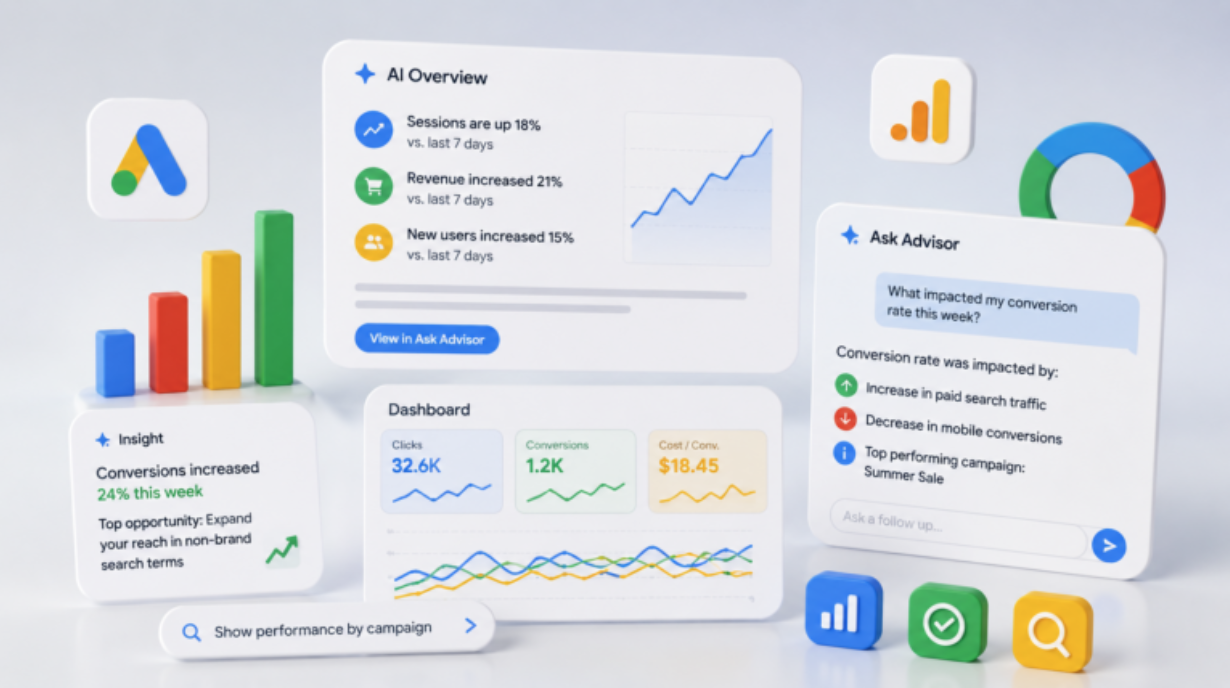
Google Analytics Will Highlight Anomalies on Its Own
AI Overviews have appeared on the Google Analytics home page. Instead of another wall of charts, the service collects notable changes into a short summary and displays them immediately after login.
For example, Gemini may draw attention to:
-
a sharp drop or increase in traffic;
-
changes in sales;
-
other noticeable deviations in the data.
For each such event, you can ask questions in plain text and dig deeper. For example, if traffic suddenly drops, you will not have to manually go through reports looking for the problematic source — you can first ask Gemini for an explanation and then check the relevant data segments.
When working with multiple sources, landing pages and campaigns, such a summary helps you notice faster when something goes wrong.
Personalized AI Insights Have Appeared in Google Ads
The Google Ads home page has also been updated. It now displays cards with AI insights generated based on the data of a specific advertising account.
There is a prompt bar next to them. You can use it to ask Gemini to analyze a question of interest. For example:
-
what affected impression share;
-
how competitors are affecting performance;
-
which trends may affect campaigns.
That is, instead of manually compiling several reports, you can immediately formulate a question and receive a summary based on your data. This may be especially useful when there are many campaigns and quickly finding the cause of a decline manually becomes more difficult.
Your Performance Can Be Compared with the Market
Another update has appeared in Google Analytics — benchmarking. It shows how a project’s performance compares with other companies in the same niche.
For example, if traffic or sales decline, an additional point of comparison appears: whether the decline occurred only for a specific project or similar dynamics are being observed across the segment as a whole.
At the same time, it will not be possible to view the figures of a specific competitor. Google uses aggregated data from a group of similar businesses, so benchmarking is intended specifically for assessing the overall picture rather than looking at someone else’s stats.
Dashboards in Google Ads Will Be Created Using Prompts
The next step — is generating dashboards using a regular text prompt. Google is already working on such a feature for Ads.
Instead of manually configuring tables and charts, you will be able to specify which data is needed, and the system will create a suitable visualization itself. For example, you can request the dynamics of the required campaign metrics and receive a ready-made chart without configuring several data segments yourself.
Important: this feature is still under development.
What Changes for Affiliate Marketers
For affiliate marketers, the most useful part of the update — is the ability to find declines in traffic campaigns faster. When many campaigns are running simultaneously, manually searching for the reason behind changes in performance takes a long time. Gemini now handles part of this work:
-
highlights noticeable changes in the data;
-
helps identify the cause faster;
-
allows questions about statistics to be asked in plain text;
-
compares performance with the market.
For example, if traffic, sales or impression share suddenly drops in one advertising account, you can first review the AI insight and request an additional analysis, and only then go into specific campaigns and data segments.
At the same time, Gemini does not replace a tracker and does not decide for the media buyer what to do with the campaign setup. Its task here is simpler — to quickly show where to look for the problem. After that, it is up to the media buyer to decide what to change: the bid, budget, creative, landing page or the offer itself.