April Facebook Storm: Why BMs Are Getting Banned and What to Do About It
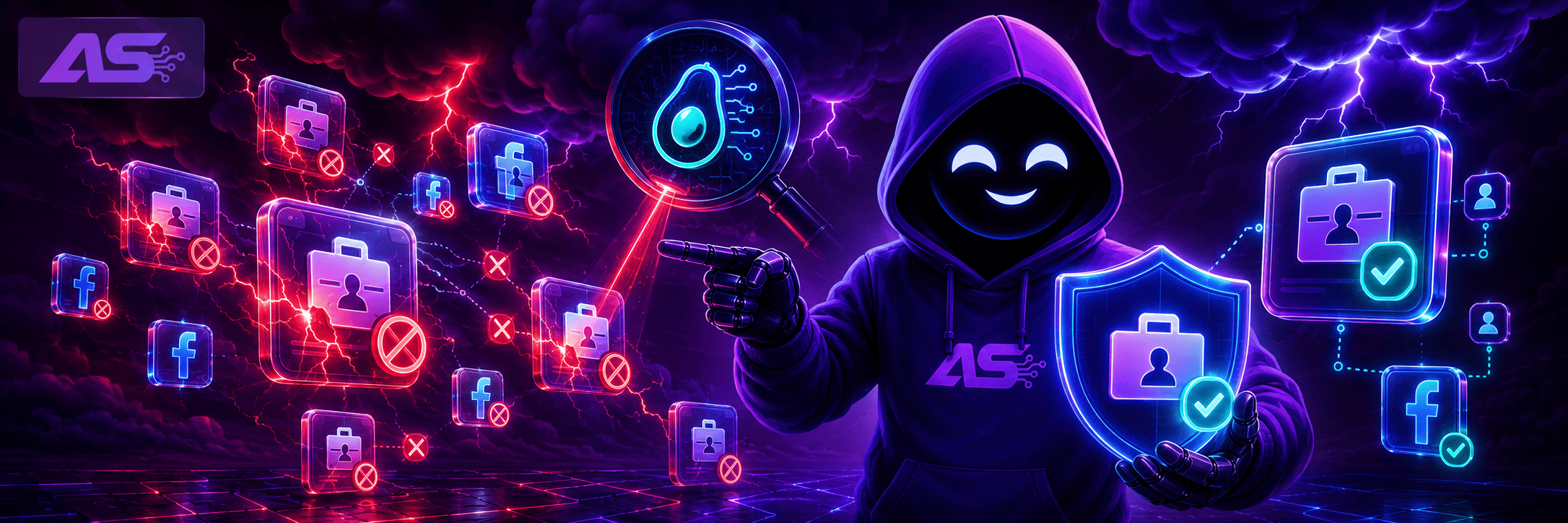
The April storm in Facebook hit everyone with its scale and illogical nature. And this time it’s not just a glitch, but a change in rules and how the algorithms work. The main blow fell on Business Managers, where the Risk Control system now takes down up to 90% of new cabinets, forcing the market to switch to more expensive and trusted consumables with verified identity.
Technical Setup and Main Cause of the Storm
The main reason for mass blocks was a large-scale update of the anti-fraud system and the integration of the Avocado neural network for full automation of moderation. But the problem is that the software is still too raw and bans even white accounts.
In addition, Facebook rolls out algorithm updates in parts across different servers. On some servers Avocado is already active, while on others old protocols are still used, causing a technical conflict. As a result, a campaign successfully passes initial moderation, but a couple of hours later it can be blocked by Avocado rules.
The situation was further complicated by changes in attribution principles: due to technical API updates, advertising accounts started experiencing failures when exchanging data.
Avocado analyzes not only visuals or text in creatives, but also technical data, including digital footprints and connections between cabinets. Previously, a simple hash replacement or metadata cleanup was enough to pass verification, but now these methods no longer work.
The new neural network detects non-unique content even after deep uniqueization: if it sees similarity with creatives from the blacklist or suspicious actions inside the BM, the ban comes instantly.

New Moderation Bypass Scheme
In current conditions, out of 100 created BMs, no more than 10 remain working. New cabinets get blocked immediately, so now most buyers use only old regs. If we look broader and take into account all selfie verifications passed and unbans after linking cards, only about 40% of the total volume of purchased consumables remain alive.
To pass moderation at the beginning of work, many create a backup BM. The scheme is as follows: the first Business Manager is launched on the account and gets banned almost instantly. Documents are submitted for unblocking, and while the check is ongoing, a second BM is created. In half of the cases, the second cabinet does not raise suspicions with anti-fraud and allows linking a card safely.
The situation is this: out of 100 BMs I got 9 working. These are old BMs that were created two or three months ago. They are alive and working without problems. Those created 2-3 weeks ago are still more or less working. All the fresh regs we created fly into ad activity restriction. Video selfies also fly in about 30% of cases», — confirms expert Pavel Shevtsov.
Access Separation: Linking and Admin Management
The main goal when building a setup is to ensure that blocking one element does not destroy the entire account network. It is necessary to strictly separate admins, ad accounts, and pages. Experts recommend allocating a separate Business Manager for storing administrators and not linking them to the social profile that holds the FP. This is a necessary measure because when a page is banned, Facebook* often blocks the entire chain.
Access transfer should be done through the “Users” tab to avoid creating direct connections between personal profiles and questionable consumables. If the FP and ad account are tied to the same social account, the profile will be banned instantly upon page rejection.
How to Launch During the Storm
If it is not possible to pause driving until the situation stabilizes, the algorithm of actions is as follows:
Work only with old BMs. In current conditions, only Business Managers created from two weeks to two months ago survive. Fresh regs fly into ZRD instantly.
Link the profile to live BMs. If the limit on creating new BMs has run out, take a reliable social account and add it to an already existing, verified BM. At the moment this is the most viable scheme.
Do deep uniqueization of creatives. Regular processing of creatives through services no longer saves. Avocado detects templates, so you need to completely rewrite headlines, change fonts, and even numbers in texts.
Observe aging periods. Before launching from a new device, cabinets need at least three days of aging.
Conclusion
The April Facebook storm was the result of the full-scale implementation of the Avocado neural network. To avoid wasting budget and consumables, it is better to temporarily abandon fresh accounts in favor of old regs and maximally isolate access between administrators and pages.
Launching campaigns during updates requires extreme caution: high-quality uniqueization of source materials and warming of FPs help bypass filters until the situation stabilizes. Until then, it is more effective to work at low volumes, betting on account survival rather than scaling.