When a media buyer enters a new GEO, the launch quickly turns into routine work: searching through spy tools, analyzing other people’s creatives, finding angles, rewriting texts, and adapting everything to local slang. Even in a team, such research takes a lot of time, especially when several different versions need to be prepared for testing at once.
With the emergence of neural networks, some of this technical work can be delegated to AI. It can quickly analyze creatives and extract the main angles used by competitors, suggest fresh ideas, create variations of texts and visuals, and adapt everything to local slang. Neural networks can then be used for landing pages and analytics: to find weak points on a page, analyze a CSV export from a tracker, and identify which campaigns, creatives, or GEOs are consuming the budget.
But entering a single line into ChatGPT and immediately getting a ready-made campaign setup will not work. If the neural network knows nothing about the offer, audience, and task, the result is usually just as superficial: basic ideas, generic texts, or poor localization. However, with the right input, AI becomes an assistant that saves a lot of time.
In this article, we will explain how to use AI at different stages of an affiliate marketer’s work: from finding ideas to analytics. We will also test everything using examples: we will see which prompts produce genuinely useful results and which ones are better avoided.
Finding ideas and analyzing competitors
Before launching a new campaign setup, you have to review dozens of other advertisers’ ads. Spy tools allow you to quickly find creatives for the required GEO, but then the routine begins: understanding which angles are repeated, which pain points competitors target, what they show in the first seconds of a video, and which offers they include in headlines.
Where to get source materials
AI does not replace spy tools and ad libraries. If you simply ask a neural network to name the «best gambling creatives for Brazil», you may easily receive a set of generic ideas instead of an actual overview of competitors.
First, you need to collect real ads. Meta Ad Library and TikTok Creative Center are suitable for free searches, while specialized spy tools can be used for more in-depth research by GEO, apps, formats, and other parameters.

Example of advertising creatives displayed in TikTok Creative Center
How to submit materials to AI for analysis
Once you have a batch of screenshots or texts, you can use a multimodal model — for example, ChatGPT, Claude, or Gemini. It can quickly analyze other advertisers’ ads according to the required parameters.
The main mistake here — submitting an overly general request.
Weak prompt: «Generate a similar creative».
In response, the neural network will most likely simply recreate what it saw: it will retain the main idea and composition while changing only a few details.
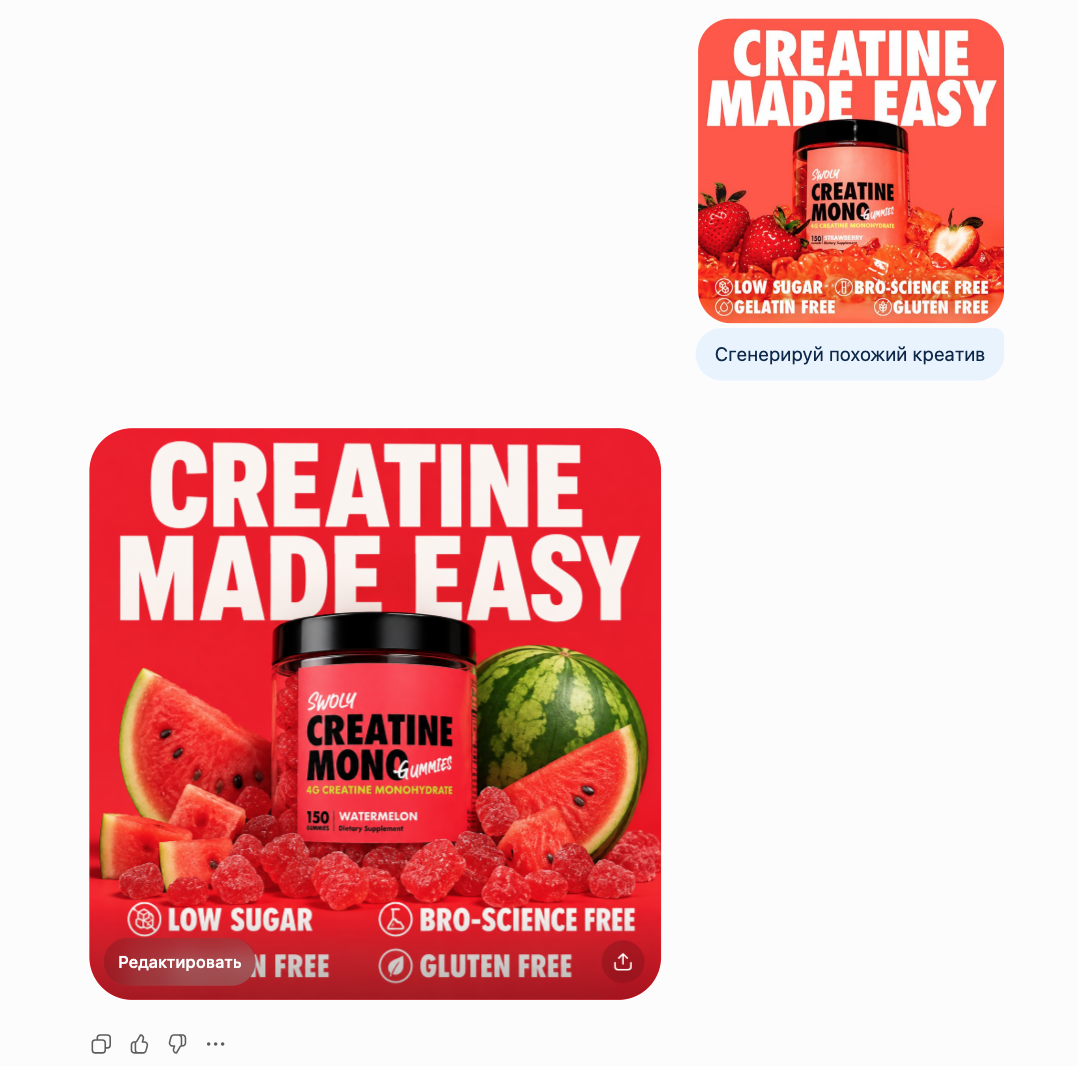
To get a useful summary, it is better to immediately specify exactly what needs to be extracted from the materials.
Effective prompt: «Analyze this advertising creative featuring creatine gummies. Identify the main angle, which audience need it targets, which product benefits are highlighted, and how the visual attracts attention. Then suggest 5 new advertising angles for this type of product. Do not repeat the “Creatine Made Easy” idea or the benefits from the original creative. For each angle, suggest a short headline and a visual concept».




The difference is clearly visible in the example. In response to the general request, AI practically repeated the original creative: it retained the composition, headline, and main product benefits, changing only a few details. The detailed prompt produced a different result: the neural network first analyzed the source material and suggested five new angles, and then created several completely different creatives based on the selected options.
At the same time, AI-generated ideas should not be treated as ready-made campaign setups. The neural network does not know the actual performance of the original ad and cannot determine which of the suggested angles will produce the best CTR or conversion rate. Its task here — to speed up research and help quickly generate more options for testing.
Texts and localization for GEOs
When launching in a new GEO, simply translating the advertising text is not enough. A phrase may be grammatically correct but sound unnatural to the local audience — too formal, too literal, or simply different from how people speak in real life. This is especially noticeable in short headlines, CTAs, UGC scripts, and creatives where the entire angle relies on natural speech.
AI significantly speeds up this work: you can provide the original text, specify the GEO and audience, and immediately receive several versions with different approaches. But a request such as «translate into Spanish» gives the model too much freedom.
For example, let us take a simple text for a dating creative:
Original: “Still single? Meet people near you who are looking for the same thing.”
And submit the most obvious request:
Weak prompt: «Translate this text into Spanish».

The result will most likely be a reasonable translation in terms of meaning. The problem is that the request does not make it clear where the text will be used: Spain, Mexico, or Argentina, which age group it is written for, and whether it should sound like an ad for a service or a natural phrase from social media.
Therefore, for localization, it is better to give the model context:
Effective prompt: «Adapt this text for a dating creative targeting Mexico. The audience — men and women aged 25–35. The text will be used in social media ads, so it should sound natural and conversational to the local audience rather than like a literal translation from English. Preserve the original meaning, but you may change the structure and wording. Provide 5 versions with different approaches and briefly explain how each one differs».
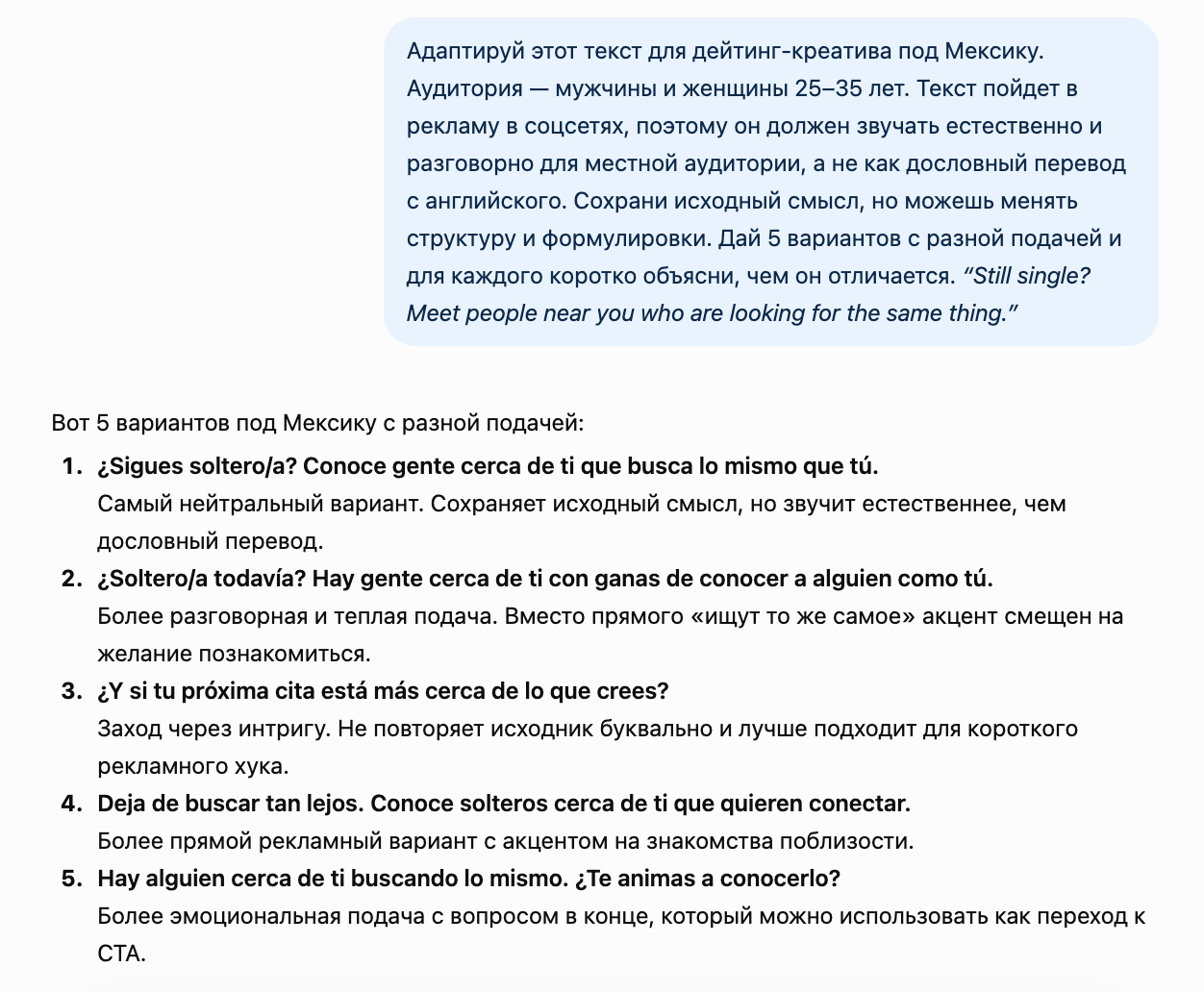
This gives the media buyer several versions to test rather than a single translation. You can separately ask the model to make a version shorter, strengthen the opening hook, make it sound less promotional, or adapt the text to a specific format — for example, Stories, UGC, or a static creative.
Do not overuse slang
There is also the opposite extreme — asking AI to «add more Mexican slang». The neural network may fill the text with so many local expressions that instead of natural advertising, it becomes a parody of how local people speak.
Therefore, it is better to ask the model to make the text sound natural for a specific GEO rather than to add slang. If a local expression genuinely fits the context, the model can use it, but there is no need to deliberately turn every headline into a collection of local words.
Even a good result should be checked before launching traffic. This is especially important if the team does not speak the language. AI may suggest a grammatically correct phrase that sounds unnatural, use an expression from the wrong region, or incorrectly assume that it is popular and current among young people. For important creatives, it is better to have the final version checked by a native speaker or at least review questionable wording separately.
Analyzing and improving landing pages
Even a good creative will not save a campaign setup if, after clicking, the user lands on a page that does not continue the original angle. The ad promised one thing, the first screen of the landing page shows something else, the required button is difficult to find, and the user has to scroll through several more screens to understand the offer.
AI can be used as an additional pair of eyes before launch. Simply upload screenshots of the page to the neural network and provide context: what is being advertised, which creative the user comes from, the GEO, and which action the user should complete on the landing page. Then ask it to review the page and identify elements that may prevent the user from moving forward.
For example:
Prompt: «I uploaded an advertising creative and several screens of the landing page it leads to. Analyze the transition from the ad to the page: whether the main offer remains consistent after the click, whether the user immediately understands the terms and price, whether the CTA is noticeable, whether there are any contradictions between the ad and the landing page, and which page elements may distract from the target action. Evaluate only what is visible in the screenshots and do not draw conclusions about CR or performance without data».
The last sentence in the prompt is not there by accident. From a single screenshot, the neural network cannot know that a specific headline, for example, reduces CR by 20% or that a green button will convert better than a red one. Without data, these are only hypotheses.
However, AI is good at noticing more practical issues: a disconnect between the promise in the creative and the first screen, overloaded sections, repetitive text, weak visual hierarchy, or a CTA that gets lost among other elements. You can then select several reasonable hypotheses from this analysis and test them with real traffic.


In our example, AI checked how logically the user moves from the ad to the landing page. It noted that the main offer remained consistent after the click but found several questionable areas: two different prices, an overloaded first screen, different CTA wording, and a shift in focus from a fixed price to weight loss. At the same time, the model did not attribute an impact on conversion to these elements but identified them as hypotheses for further testing.
AI is also useful during the improvement stage. For example, you can ask it to suggest several versions of the first screen for a specific angle, shorten a long section without losing its meaning, or rewrite the CTA. If you have the page code, the model can also help with HTML/CSS or prepare specific changes for the frontend developer.
Important: neural network analysis — is not a replacement for an A/B test. AI can identify a potential problem and suggest how to fix it, but only real traffic can show whether the conversion rate increased afterward.
Advertising campaign analytics
After launching traffic, AI can be used to analyze the numbers. When an export contains dozens or hundreds of campaigns, you have to manually switch between segments, compare CTR, CPC, CPA, and ROI, and find exactly where the campaign setup starts to decline. A neural network can quickly review the entire table and highlight the areas that should be checked first.
A CSV or Excel file from a tracker or Ads Manager is suitable for this type of analysis. The file can be uploaded directly to ChatGPT or Claude, along with an explanation of which metrics are important and exactly what needs to be found.
But a request such as: «Analyze my campaigns and tell me what to turn off» — is a bad idea. Without additional input, AI does not know the acceptable CPA, the offer payout, or other terms of the campaign setup. As a result, the model may decide for itself which metrics should be considered good or bad and draw the wrong conclusion.
It is much more useful to provide not only the table but also the context. For example: «Analyze this advertising campaign export. The payout for an approved lead — $45. Compare campaigns by Spend, CTR, CPC, Leads, CPA, and ROI. Find campaigns and creatives that spend the budget but are not profitable, as well as cases where a high CTR does not generate leads. Do not draw definitive conclusions about rows where there is still too little data, and do not invent missing metrics. Present the results in a table and briefly explain which campaigns should be checked first and why».
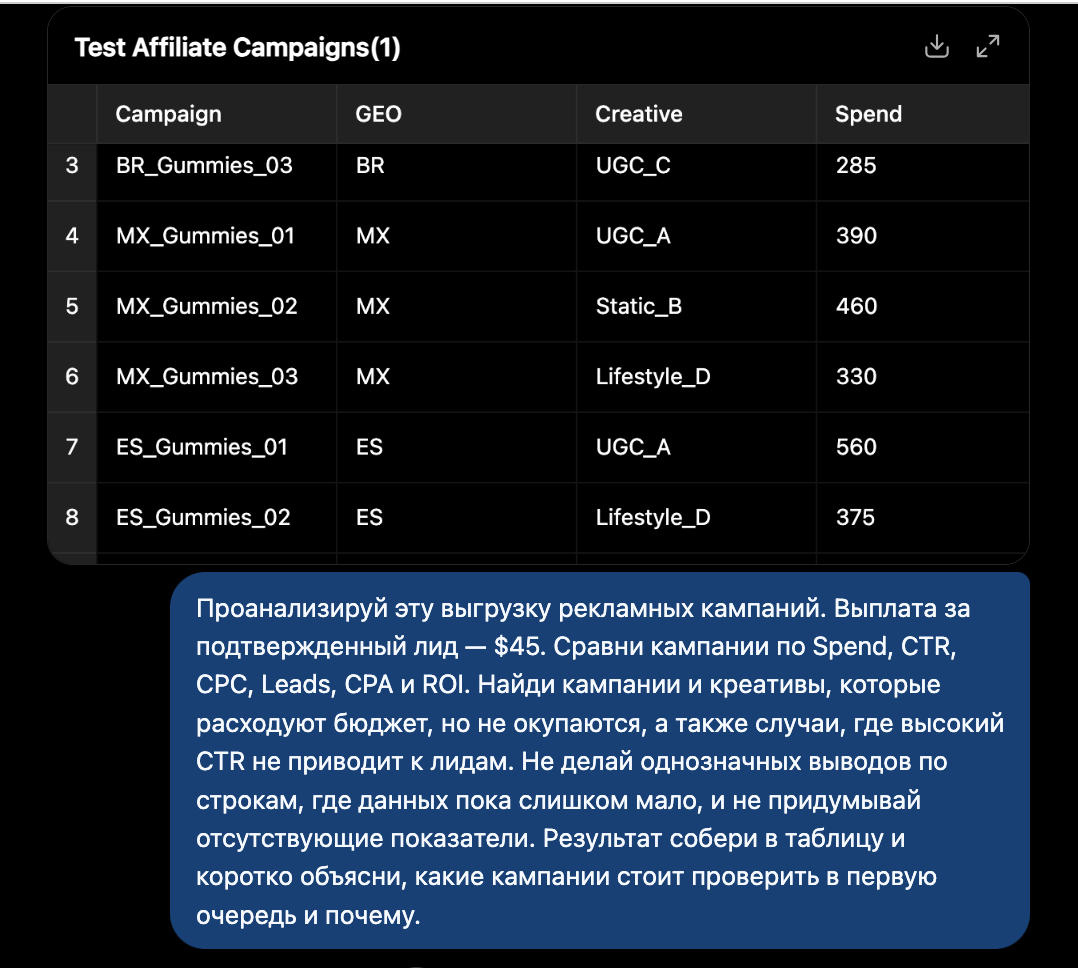
This analysis helps quickly identify more than just obvious wasted spend. For example, a creative may generate a high CTR and cheap clicks but produce almost no leads. In another case, the CPA looks excellent, but there is still too little campaign data — it is too early to draw conclusions about the stability of the campaign setup. If you simply sort the table by a single metric, such issues are easy to miss.
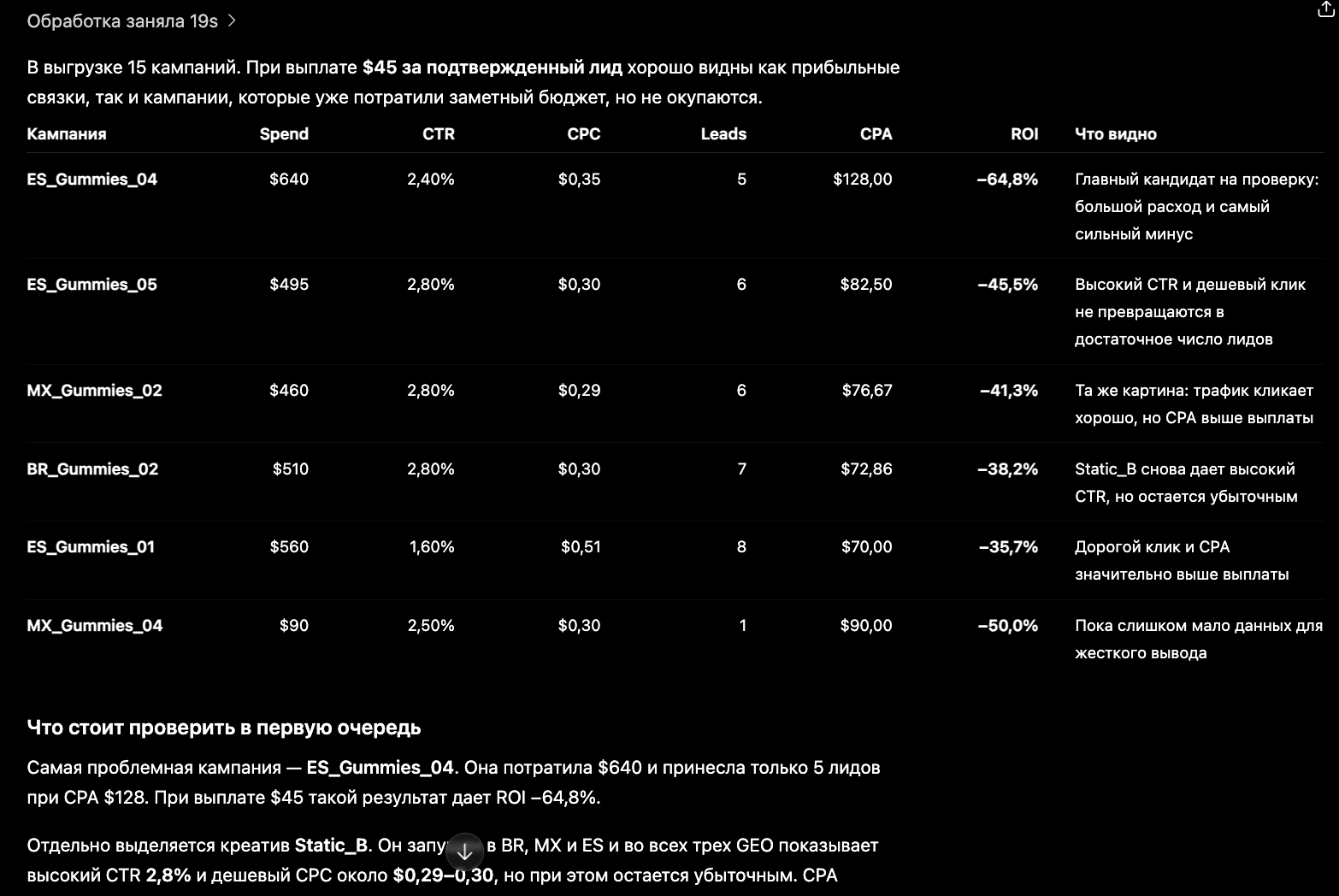
If necessary, you can dig deeper with separate requests: compare results by GEO, devices, or placements, find creatives with similar performance, calculate additional metrics, or create charts from the export.
At the same time, it is better not to delegate the decision to turn off or scale a campaign entirely to a neural network. AI sees only the data and conditions it was given. It can highlight an anomaly or help identify a pattern, but it does not know the entire delivery history, the specifics of the offer, or the situation in Ads Manager. Therefore, its conclusions should be used as a quick preliminary analysis rather than as a command to «turn off campaign No. 7».
What should not be fully delegated to AI
Despite all the capabilities of neural networks, it is still too early to fully delegate traffic campaign decisions to them. AI sees only the part of the campaign setup it receives as input. It may find a suspicious campaign in a CSV or suggest a new angle, but it does not know the entire account history, the specifics of the offer, lead quality, or what happened with ad delivery before the export.
Facts should also be verified separately. A neural network may confidently invent a product feature, misinterpret data, or refer to a nonexistent advertising platform rule. This is especially critical for finance, nutra, and other verticals where a mistake in a creative may result not only in a failed test but also in moderation issues.
Another important point — the data uploaded to the model. Lead databases, payment details, logins, API keys, and other sensitive information should not be submitted to a regular chat. Before uploading work-related tables, it is better to remove everything that is not required for the specific analysis.
Therefore, the optimal approach for now is as follows: AI handles research, draft work, and the processing of large amounts of information, while the media buyer reviews the results and makes the final decision.
Conclusion
The examples in the article clearly show one pattern: the more specific the task and the better the source data, the more value you can get from AI. One general prompt gave us an almost exact copy of another advertiser’s creative, while a detailed analysis — produced several new angles at once. The same applies to localization, landing pages, and analytics: without context, the neural network is forced to make assumptions on its own.
Therefore, there is no need to chase dozens of AI services. It is much more important to learn how to provide neural networks with the right data and clearly explain the required result. The same tool can then be used at different stages of the workflow: analyze competitors, generate angles for testing, adapt texts for a GEO, check a landing page, or quickly review a large export.