Google has updated its Limited Ad Serving policy. Now, the search engine automatically limits the reach of campaigns that appear to be impersonating well-known brands, without requiring complaints from trademark owners or manual moderation. The ad isn't banned — its impressions are simply reduced to a minimum.
What has changed in the rules
Previously, limiting ad impressions required a complaint from a brand or a manual review. Now AI handles everything. Major company names and high-volume keywords are the primary targets.
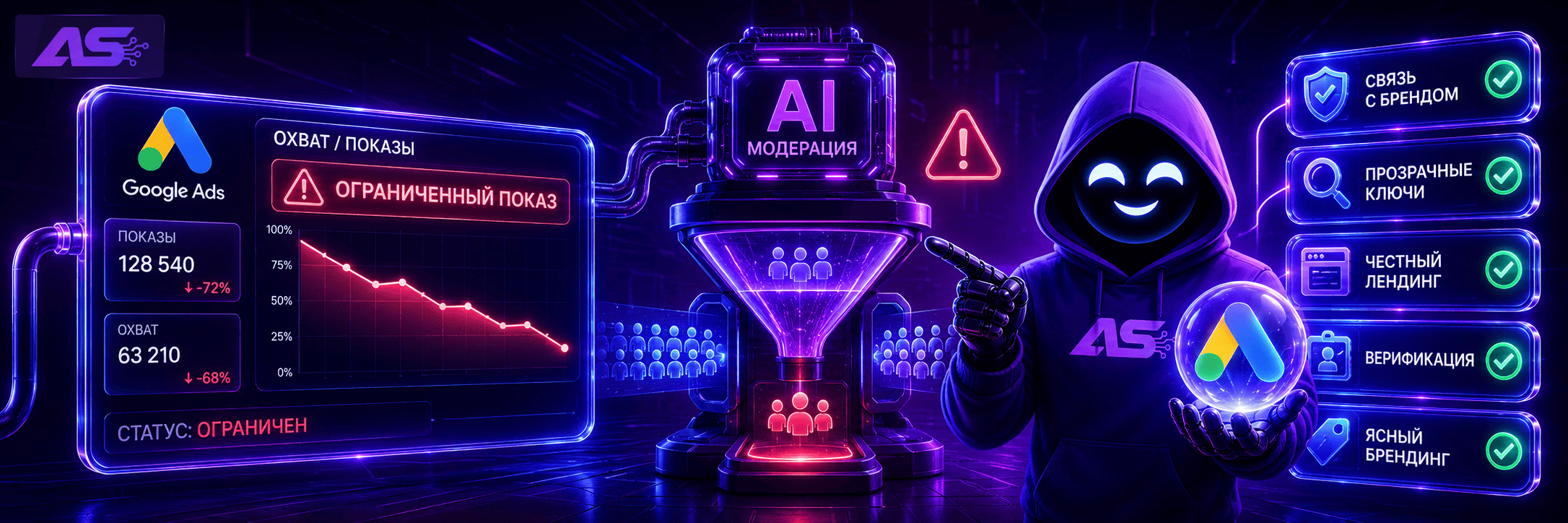
The algorithm evaluates three factors:
-
Account connection to the brand. Has the advertiser completed verification, and is the account associated with the trademark owner?
-
Landing page. The domain, design and landing page content are analyzed to determine whether the website is impersonating another company.
-
Advertiser. Has identity or business verification been completed, and does it match what is being advertised?
Anonymous promotional pages and landing pages automatically fall under these restrictions. If a website lacks legal entity information, a privacy policy or clear branding, the campaign will face impression limits. Google explains this by saying that users shouldn't confuse an official website with an affiliate or review website.
Who is affected
The update affects everyone who uses other companies' branded search queries in advertising. And such advertisers make up the majority in Google Ads.
Casinos and betting. Casino affiliate websites, bookmaker review portals and promotional pages offering bonuses — anyone using well-known brand names in keywords and headlines.
Affiliate marketers and CPA networks. Those driving traffic to offers from major brands, including crypto exchanges, banks and marketplaces, while using their names as keywords. Without clear positioning such as «we are a review website» and account verification, impressions will be restricted. Pre-landing pages without company details and privacy policies are among the first to face restrictions.
Affiliate programs and review websites. Comparison websites covering banks, services and online platforms that use these brands' names as keywords. The algorithm now evaluates how independent the resource appears.
E-commerce and physical product offers. Advertisers promoting popular products or using well-known cosmetics, electronics and clothing brand names in their ads. Especially when the landing page visually copies the brand's official website.
Financial sector. Advertising microloans, investment services and crypto platforms using the names of major banks or well-known exchanges in ads is becoming practically impossible.
Local businesses and franchises. Companies that use the names of major chains or well-known manufacturers in their advertising but cannot verify their partnership.
How to adapt
The platform now requires transparency. Here's what you need to do to prevent your campaigns from facing impression limits:
Make your website recognizable. Your landing page should look like an independent resource. If you're an affiliate or a review website, state this clearly. Provide legal entity information, contact details and a privacy policy. Clear identification — is the main signal to the algorithm that you're not misleading users.
Work with trusted domains. Older domains with a clean history raise fewer questions for the algorithm than newly registered domains. For campaigns targeting high-volume branded keywords, it's better to use an established domain.
Complete advertiser verification. Google Ads has a process for verifying identity and business information. Restrictions are applied more frequently to unverified accounts.
Don't copy other websites. Landing pages that visually imitate well-known brands' websites are immediately restricted. Create genuine reviews, comparisons and rankings where another brand is mentioned in the context of analysis rather than presented as your own.
Google is tightening its search advertising rules because it believes users should understand where they're clicking. If an ad is placed by an affiliate or review website rather than the brand itself, that should be clear.
For those who operate honestly, the update is more of a benefit: fewer competitors exploiting other companies' brand names, higher-quality traffic and lower cost per click. Those who built campaigns around impersonating well-known brands will have to adapt by investing in quality landing pages, verification and their own branding.
The update has already taken effect — it's worth checking your campaigns now to avoid losing reach in the coming days.